Certificate of Insurance Automation Software Comparison
Issuance and tracking software solve opposite problems, and buying the wrong one wastes hours daily.
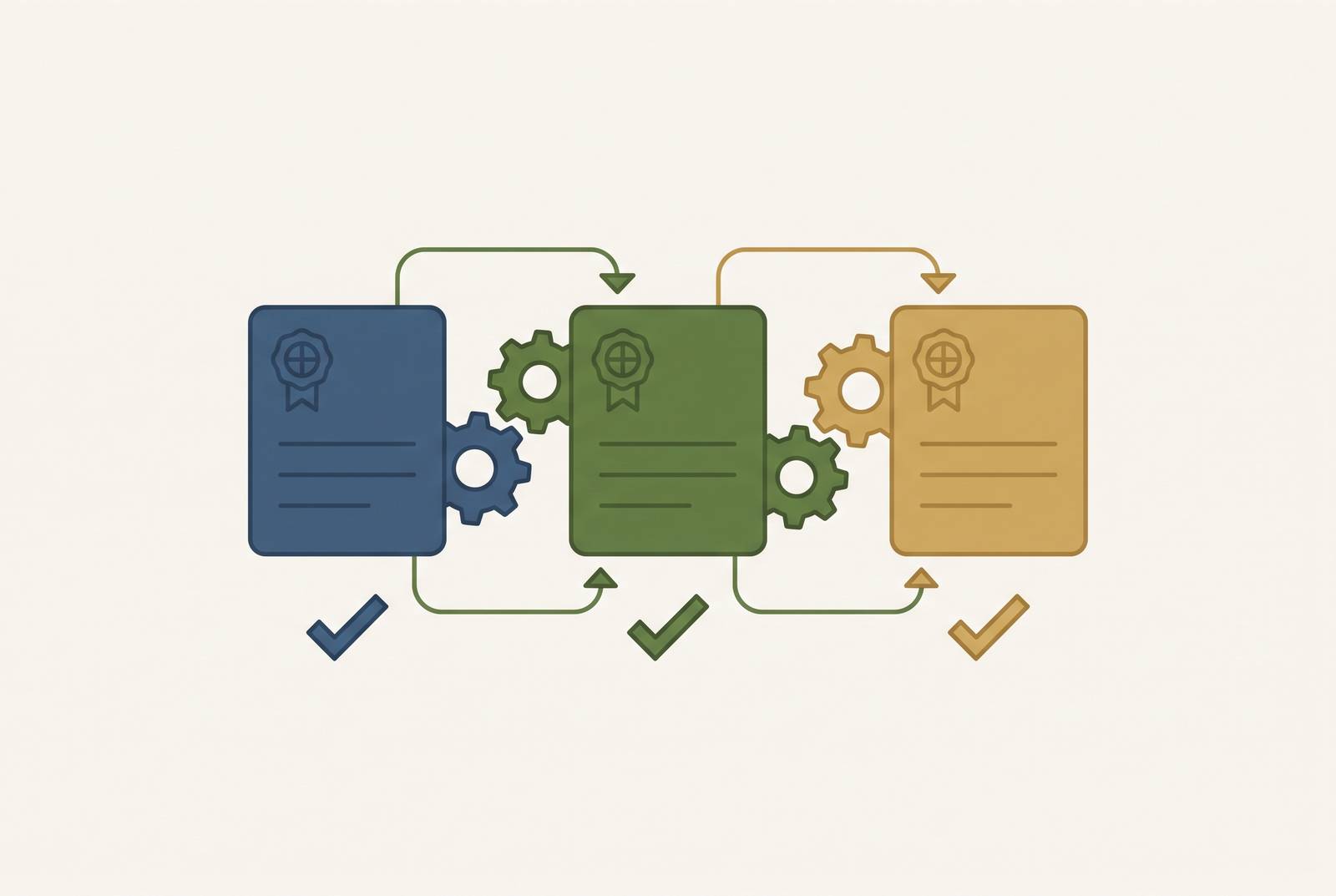
Certificate of insurance software splits into two markets that solve opposite problems: issuance tools that help agencies generate certificates for policyholders, and tracking tools that help vendors' clients, property managers, and procurement teams collect and check certificates coming in from subs, tenants, and suppliers. Picking the wrong category means buying software that automates a workflow you don't run. An agency drowning in outbound certificate requests doesn't need a compliance tracker, and a general contractor buried in subcontractor paperwork doesn't need an ACORD 25 generator. The two problems look similar on paper, since both involve the same certificate, but the people doing the work, the systems they touch, and the failure modes they're guarding against have almost nothing in common.
Getting this wrong costs hours, measured directly in lost staff time and client wait time, not in some vague notion of "inefficiency." A CSR generating a single certificate by hand loses 12 to 25 minutes to it, and clients wait 4 to 8 hours for a document that should take under a minute to produce. On the tracking side, a compliance coordinator chasing expired certificates, missing endorsements, and vendors who won't answer the phone spends 3 to 4 hours a day on that alone. Modern tracking platforms bring that under 30 minutes. Both numbers point at the same fact: certificate work is repetitive, rule-based, and exactly the kind of task software should have swallowed years ago. Most agencies still run it by hand anyway.
What agencies should look for in COI issuance automation
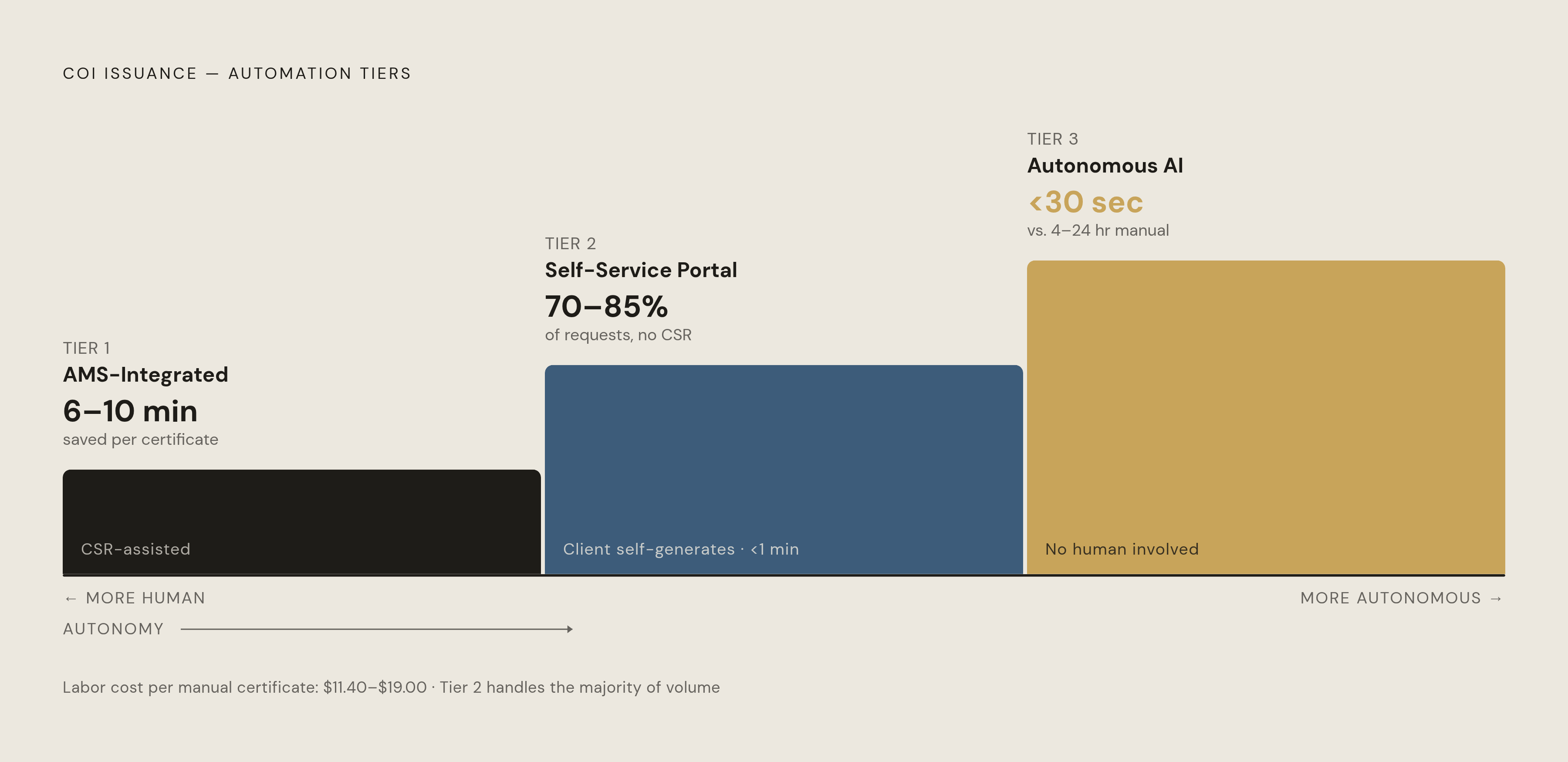
Issuance automation, at its plainest, replaces a CSR's manual data entry with a system that already has the answer sitting in it. A CSR picks the client, picks the certificate type, types in the certificate holder's name, and the software pulls policy data straight from the agency's own records to fill out an ACORD 25 or ACORD 28. That step alone saves 6 to 10 minutes per certificate over typing it from scratch, and it's the floor, not the ceiling, of what any agency running real certificate volume should expect from its tools.
The next tier hands the work to the policyholder directly. A client logs into a self-service portal, types in the certificate holder's name and address, and the system generates and emails a finished certificate in under a minute, any hour of the day, with no CSR touching it. Agencies running this tier report it handles roughly 70 to 85% of inbound COI requests without a person involved. The rest, the odd requests, the non-standard endorsements, the client who insists on talking to someone, route to a CSR the normal way.
The top tier removes almost all human involvement. An autonomous AI certificate engine turns a request around in under 30 seconds at a fraction of the manual labor cost. Set that against the manual baseline, 4 to 24 hours of turnaround and $11.40 to $19.00 in labor cost per certificate, and the gap isn't an efficiency gain so much as a different category of tool wearing the same name.
None of this runs on its own. The agency management system is the root cause of most quiet failures in issuance projects: it makes or breaks the outcome because the AMS alone rarely covers what full automation needs. Applied Epic, Vertafore AMS360, and HawkSoft all ship with some flavor of template-based certificate generation, but real-time policy syncing, self-service portals, and audit trails have to get bolted on by middleware layered on top. Anyone evaluating issuance software should ask, before anything else, how deep that AMS connection actually goes. A certificate engine that can't talk cleanly to the AMS is just manual entry with a better coat of paint.
The four AI technology levels that separate COI tracking platforms
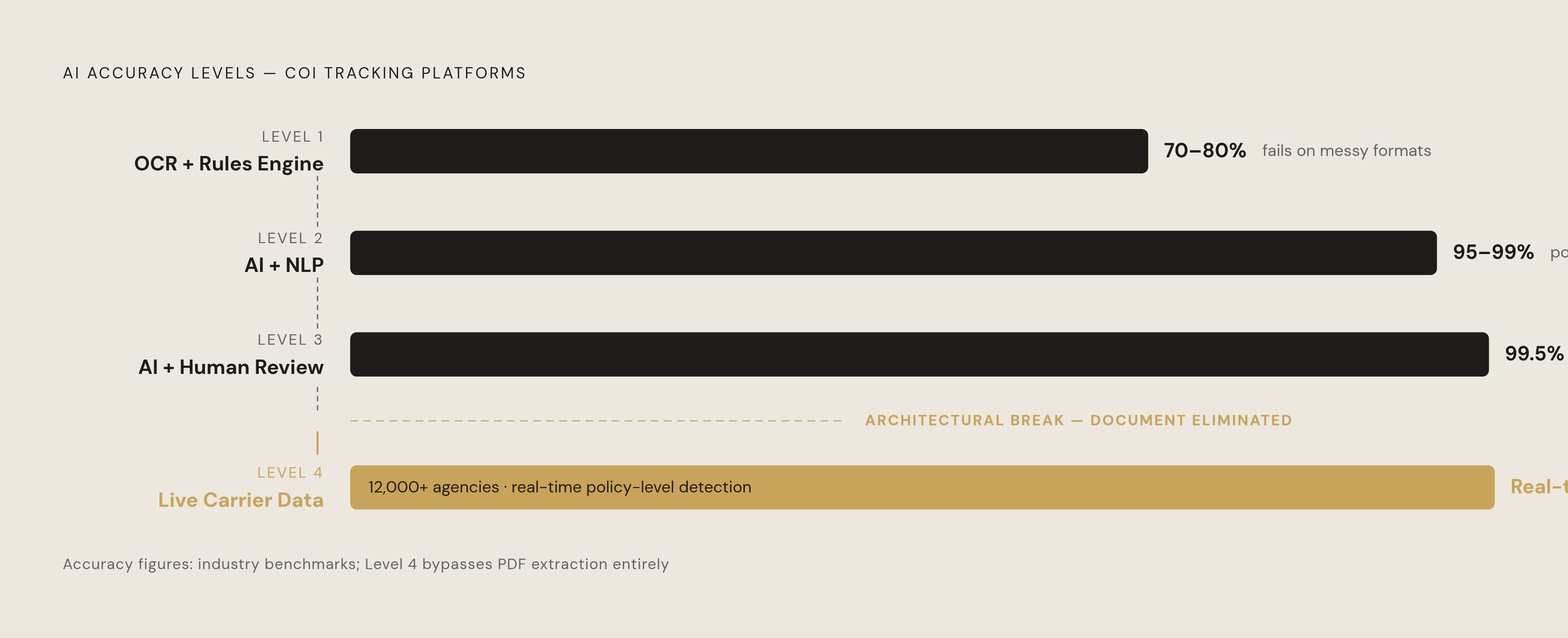
Every major COI tracking platform in 2026, BCS, Jones, illumend, TrustLayer, myCOI, Certificial, uses AI at some stage of its workflow. That word covers four genuinely different technology levels, and the accuracy ceiling changes a great deal from one to the next. Buyers who stop at the marketing copy end up comparing products that aren't in the same league.
Level 1 is OCR plus a rules engine: software that reads characters off a page without understanding what any of them mean. Industry estimates put accuracy at 70 to 80% on a clean, standard ACORD certificate. That number falls fast when the document gets messy, as with a non-standard layout, a poor scan, or a broker's custom template.
Level 2 moves to AI and natural language processing, actually parsing meaning instead of just characters, and self-reported accuracy climbs to 95 to 99%. Level 2 tools work on a document frozen at one moment in time, so they can tell you what a certificate says the day it lands in the inbox, but they have no way to catch a policy that gets cancelled or endorsed differently three weeks later.
Level 3 bolts a human review layer onto the AI, and self-reported accuracy pushes to 99.5%. That extra half-point costs something real: turnaround stretches by hours or days, and the model gets expensive fast once volume climbs, because a person is still reading every certificate the software flags.
Level 3 is the ceiling for anything still working off a document. Getting past it means changing what the software looks at from the start. Certificial's approach, covered later in this piece, breaks from the pack on this point.
COI tracking platforms for construction and real estate: where most of the market complexity lives
Construction breaks generic compliance software faster than any other vertical. Tracking has to happen at the project level. Subcontractor counts run high and turn over constantly. Everything has to sync with Procore or whatever ERP the GC already runs on, and the endorsement language itself gets specific: additional insured status, waiver of subrogation, completed operations coverage, all of it the kind of detail a generic platform tends to miss or flatten out.
Billy built its product for construction general contractors specifically, covering the full compliance lifecycle from vendor onboarding through COI collection, AI document review, and renewal outreach, tied into the ERP systems GCs already run. Its integration list is the deepest of anything covered here: native Side Panel inside Procore, plus Autodesk, Viewpoint Vista, Sage 300 CRE, Sage Intacct, JD Edwards, and CMiC. Subcontractors upload certificates from a link with no account creation required, which knocks out what is usually the single biggest bottleneck in collection: getting vendors to log into yet another portal. Billy claims the combination removes an estimated 90% of manual COI work. Pricing isn't public and requires a sales call, a fair signal this is built for mid-size to large GC operations rather than a two-person subcontractor shop.
Jones is the best-funded platform in this category, having raised a $15 million Series B in January 2025, and the depth of its integrations tracks the capital. Its Procore integration runs as a side-panel app with bidirectional sync rather than a simple link-out, and it holds an official CMiC Partner Built Integration, a level of depth few competitors match. The platform runs certificates through three steps, AI review, expert manual review, and a QA pass, and publishes a self-reported audit accuracy of up to 99.9%, alongside a 24-hour COI verification SLA posted on getjones.com. The tradeoff is scope: Jones only serves real estate (commercial and residential) and construction, so it's not built for buyers outside those two verticals, and pricing is enterprise-only, quote on request, not sized for small operations.
PINS Advantage runs on a self-service model: the buyer sets its own requirements, vendors and brokers submit certificates through a no-login upload link, and an AI Assistant checks each certificate against those requirements and flags gaps with the reasoning behind each flag, while the compliance decision itself stays with the buyer's team rather than the software. That AI Assistant launched in November 2025, replacing what had been a purely OCR-based system, which moves it past pure OCR toward AI and NLP-based document understanding. Human review is still on the buyer to manage, not the platform. It offers Procore and Vista integrations and is positioned for general contractors already living inside those systems.
COI tracking platforms for multi-industry and enterprise use cases
Certificial takes a fundamentally different approach from every other platform in this piece, and it's the one genuine architectural break in the category. Instead of processing a PDF certificate after the fact, it connects directly to participating insurance carriers and agent management systems to pull live policy data, which removes the PDF from the workflow entirely rather than reading it more accurately. That network reaches more than 12,000 insurance agencies and gives Certificial real-time, policy-level change detection, the only platform here operating at what amounts to a fourth level: agent-verified structured data instead of extracted text. Its AI pulls out exclusion language and puts it in front of a human for review rather than issuing an automated pass or fail, though further automation is planned in future releases. PowerFlex, cited as a case example, moved from a 60 to 70% compliance rate to roughly 90% after switching off a document-based tool and onto Certificial. More than 25,000 agencies use the platform, and it's the only major platform in this comparison built to serve both requestors and agencies or brokers inside one system, covering issuance and tracking together.
CertFocus, built by Vertikal RMS, is positioned as a full-service AI-powered COI management platform, and its client list backs that up at scale: Ace Hardware, Buffalo Wild Wings, and NASCAR all run on it. Organizations that switch to CertFocus routinely move from under 60% compliance to over 90%. Pricing is published outright, a rarity at this tier: self-service runs $6 to $8 per vendor, and full-service with credentialed professionals doing the review runs $13 to $29. CertFocus serves 25 vertical markets across both service tiers.
BCS (Business Credentialing Services) runs an AI-plus-human managed-service model by design, not as a stopgap, and it publishes its pricing at 95 cents per vendor per month, with a free tier for the first 25 vendors. Its network holds more than 98,000 pre-vetted vendors, so a new subcontractor signing onto a project is often already sitting in the system somewhere. Jones also maintains a vendor network, and Certificial's reach of 25,000-plus is agencies, which makes the comparison closer than it first looks. Technologically, BCS is Level 2 to 3: RiskBot, its AI layer, launched in 2025, and the hybrid model routes complex certificates to a human reviewer instead of forcing everything through automation.
SmartCompliance spreads across commercial property management, hospitality, government, banking, healthcare, construction, and retail, with both full-service and self-service tiers. Its feature set covers COI management, insurance collection automation, OCR, compliance analytics, and customizable risk reporting. It falls short on integration depth, offering a narrow set of third-party integrations, a narrow footprint next to construction-native competitors like Billy or Jones, and a real limitation for any team already running operations through Procore or an ERP. Slower help desk resolution has also been flagged as an issue, which can delay compliance reporting at exactly the moment a team needs it fastest.
Where extraction-only tools fit in a larger COI stack
Extraction and lifecycle management solve different problems, and treating them as interchangeable is where a lot of buyers go wrong. An extraction tool pulls structured data out of a certificate: names, dates, limits. A full lifecycle platform does the surrounding work: sending the request, tracking the expiration date, flagging non-compliance, following up on renewals. Neither one substitutes for the other, and buying one expecting it to behave like the other is how compliance gaps happen six months in.
Lido is squarely in the extraction category. It pulls insured name, policy numbers, coverage types, limits, dates, carriers, and additional insured endorsements from any ACORD or custom COI format, whether that's a clean PDF, a scan, a fax, or a photo taken on a phone, with no template setup required beforehand. It reports 99.9% accuracy, runs $29 a month, and holds SOC 2 Type II compliance. What it doesn't do, and isn't trying to, is track compliance over time, manage vendors, send automated request emails, or run renewal workflows. The right buyer for Lido is a risk manager or compliance team that needs clean, structured COI data flowing into some other system, a tracking platform, a data warehouse, an internal dashboard, and just needs the extraction step handled well instead of handled everywhere at once.