Digital Payment Processing Options for Insurance Premium Collection
Insurers are ditching checks for digital rails that cut costs and boost customer retention.

The insurance industry is running two payment systems at once: a legacy check-and-lockbox process still limping along, and a fast-growing digital layer built on ACH, real-time rails, cards, and embedded checkout flows. The global insurance market is projected to grow from $7.7 trillion in 2024 to $8.3 trillion in 2025, but the more telling number is underneath that figure. The digital insurance payment platforms segment, valued at $485.0 million in 2025, is projected to reach $1,133.9 million by 2033, growing at an 11.2% compound annual rate from 2026 onward. That's the infrastructure layer becoming its own business, and it's growing because payments have become the single most visible touchpoint a carrier has with a policyholder. A slow claim payout or a clunky billing portal does more damage to retention than almost anything else in the policy lifecycle, and the money now moves in two directions that both matter: premiums and fees coming in, claims and refunds and commissions going out.
Where insurers stand today: digital adoption and the legacy gap
Consumer behavior has already moved. In 2024, 92% of consumers in one large consumer market consumers used some form of digital payment, a new high, and by 2025, 78% of premium payments in that market insurance premium payments were processed digitally. That gap, 92% versus 78%, is the whole story in two numbers: insurance is catching up to general consumer habits, but it hasn't caught up yet.
The generational split makes the pressure sharper. Roughly 65% of millennial and Gen Z policyholders expect instant payment options through a mobile app, and payment speed has become a documented factor in policyholder retention decisions. That's not a preference, that's churn tied directly to payment speed.
On the carrier side, only 68% of large insurers in that market insurers confirmed full deployment of digital premium and claims payment systems across all policy lines in 2025. Read that the other way: roughly a third of large insurers have not finished the job, and plenty of mid-size and regional carriers are further behind still. Electronic methods now account for 65% of insurance payments overall, with paper checks holding the remaining 35%. Checks are declining, and any carrier still budgeting for check processing as a permanent line item is planning against a trend that's already reversed.
ACH transfers: the workhorse of recurring premium collection
ACH remains the backbone of premium collection, and for good reason. Consumer-initiated ACH payments hit 11.4 billion in 2025, up 6% year over year, and recurring premium payments make up a meaningful chunk of that volume. The cost math is straightforward: ACH transactions run $0.20 to $1.50 per transaction, flat, regardless of the amount being moved. A percentage-based card fee on a large commercial premium makes the gap obvious fast. One insurer cited in industry reporting achieved over an 800% improvement in reimbursement efficiency simply by switching from paper checks to ACH, which says as much about how bad the check process was as it does about how good ACH is.
Timing is where ACH shows its age, though it's aging well. Standard ACH settles in one to three business days. Same-Day ACH narrows that gap with three daily processing windows, at 10:30 a.m., 2:45 p.m., and 4:45 p.m. Eastern, giving carriers a practical middle ground between old-school batch settlement and the instant rails covered next.
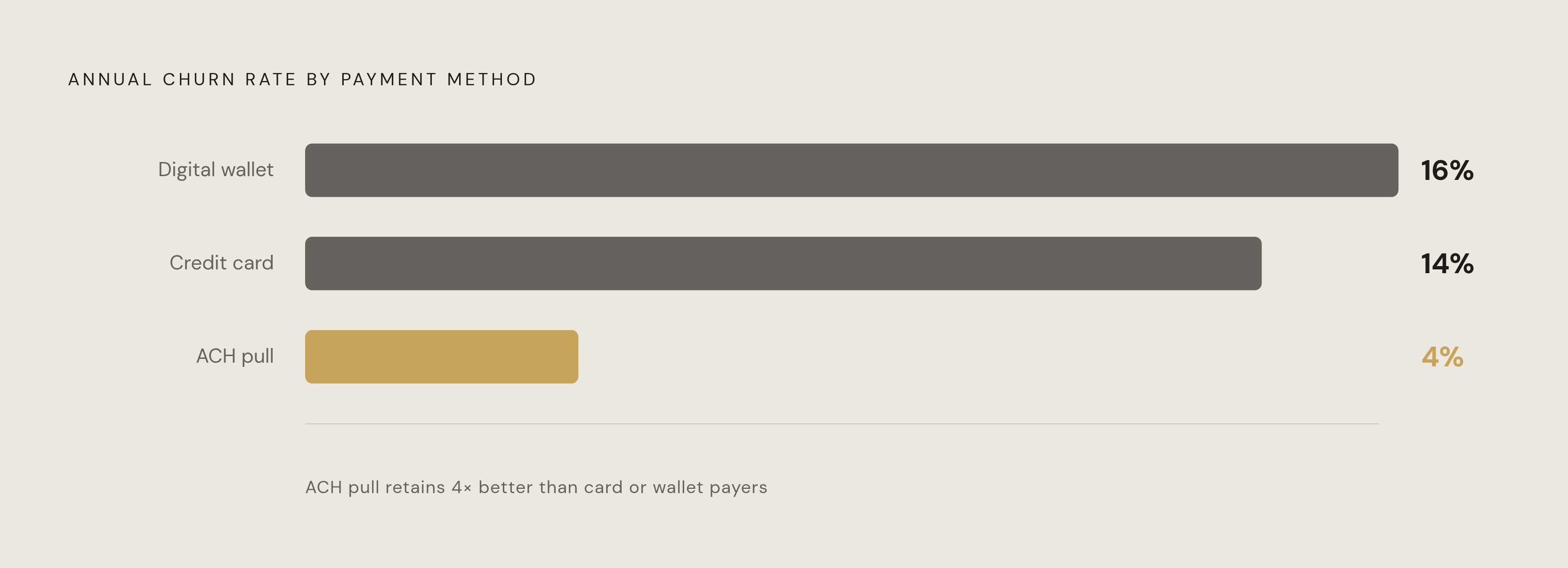
The retention data is the part underwriters and finance teams tend to miss. ACH Pull customers show roughly 4% churn, compared to 14% for credit card payers and 16% for digital wallet users. How a customer pays their premium predicts whether they'll still be a customer next year, and that is a strategy signal. The flip side is real too. Somewhere between 10% and 15% of failed payments can turn into bad debt. Payment method selection isn't purely a finance department decision; it's a retention lever with a dollar cost attached to getting it wrong.
Real-time payment rails: when speed of settlement becomes a competitive differentiator
Demand for instant payment isn't a hypothetical anymore. Among consumers receiving insurance-related disbursements who had a choice of method, 34.8% picked "instant payment" as their most-used option. That's a plurality of an informed, opt-in group, which is a stronger signal than a general satisfaction survey.
Two networks are doing the work here. RTP, run by The Clearing House, and FedNow, run by the Federal Reserve, both operate 24 hours a day, every day of the year. RTP raised its per-transaction limit to $10 million in February 2025 specifically to handle high-value commercial disbursements, insurance payouts included. FedNow's reach grew fast too: over 1,600 financial institutions were live on the network by the end of 2025, a roughly 45% increase year over year.
Real-time rails cannot simply replace ACH because of a structural catch. RTP and FedNow are credit-push only: they can send funds but cannot pull them. Request for Payment functionality, which would allow real-time debits, is still being built out across both networks. Until that matures, real-time rails are a tool for paying claims and refunds fast, not for collecting recurring premiums the way ACH does.
The upside runs past customer experience. Faster premium collection improves cash flow and cuts Days Sales Outstanding, and both networks carry enough remittance data attached to each transaction to support automated reconciliation, which matters more than it sounds once transaction volume gets into the thousands per month.
Cards and digital wallets: balancing policyholder convenience against processing cost
Cards cost more to accept. Processing fees run 1.5% to 3.5% of the transaction value, against ACH's flat per-transaction fee. On a $1,800 annual auto premium, even the low end of that range adds up to a real cost once it's multiplied across a book of business. Cards should be used deliberately rather than avoided.
Cards make sense for one-time payments, down payments, application fees, and any moment a policyholder specifically wants the rewards or points that come with using their card. Steering recurring premium payments toward ACH while still accepting cards at the point of sale or renewal is a common setup, and a rational one. Chargeback risk runs higher with cards than with ACH, too, so the convenience has to be weighed against the dispute-management overhead it creates on the back end.
Digital wallets, Apple Pay, Google Pay, PayPal, Venmo, are the fastest-growing payment method in the country right now. Transactions through these wallets are expected to grow 77% by 2028, crossing $16 trillion. Carriers ignoring wallet acceptance aren't avoiding a cost, they're avoiding a channel their own policyholders are already using everywhere else.
Buy Now, Pay Later and premium financing: making coverage accessible without absorbing the credit risk
Premium financing solves an old, specific problem. Businesses buying commercial coverage have traditionally had to pay the full premium as a lump sum, which strains working capital right at the moment they need coverage most. BNPL-style structures let the policyholder get coverage immediately while spreading the cost over time, without the carrier itself carrying that credit exposure.
The same consumer BNPL names showing up at retail checkout, Affirm, Klarna, Afterpay, are now showing up in insurance checkout flows too. ePayPolicy's Finance Connect is one example of a premium financing integration built specifically for insurance rather than adapted from retail. Vendor estimates suggest BNPL adoption increases conversion rates, though those numbers come from the vendors selling the product, and independent verification is worth demanding before anyone treats them as settled fact.
The cost to the policyholder is not trivial rather than buried in fine print. Installment and installment and financing fees can add $50 to $200 on top of the base premium. The total cost of financing coverage adds up meaningfully over the course of the year. Disclosure is a compliance obligation, and carriers offering these products need plain-language terms that make the true cost obvious before the policyholder signs up for convenience.
Embedded payments: collecting premiums inside partner platforms and third-party ecosystems
Premium collection is moving off insurer-owned portals and into wherever the customer already is: auto dealerships, travel booking sites, mortgage origination platforms, fintech apps. Embedded payments let a carrier collect premium directly inside somebody else's checkout flow instead of redirecting the customer to a separate insurer-branded page.
That shift raises the technical bar considerably. Running a standalone payment portal is one kind of problem. Embedding a compliant, secure payment flow inside a third party's user interface, one the carrier doesn't control the design of, requires secure APIs, flexible payment gateways, and infrastructure built for compliance from the start rather than bolted on after.
One major region held a 38% share of the insurtech market in 2025, which tracks with where embedded fintech investment has concentrated and explains why this architecture shift is happening there first. Stripe Connect is one working example of the infrastructure behind it, built to split payments programmatically across multiple parties and embed insurance payments inside third-party ecosystems. Guidewire's BillingCenter integration is a named example of this pattern in the market.
Compliance, security, and fraud controls that apply across every payment method
None of the payment methods above operate outside the rules, and the rules stack. PCI-DSS governs how card data gets handled, full stop. State insurance regulations separately govern premium collection timing, refund rights, and lapse procedures, and those requirements don't bend for a new payment rail just because it's faster or cheaper. Together they determine which vendors a carrier can even consider, and how the payment flow has to be built from the ground up.
Tokenization and encryption aren't differentiators anymore, they're the floor. Multi-factor authentication and fraud analytics are becoming standard right alongside them, and any vendor that doesn't offer this baseline set should be disqualified on security grounds before cost or features even enter the conversation.
ACH carries its own fraud considerations that carriers need to account for. Open banking tools that use APIs to verify bank account ownership and balance before a transaction even initiates cut down on both returned payments and fraud at the point of origination, which is a meaningfully better place to catch a problem than after the money has already moved.
Real-time rails cut the other way. RTP and FedNow's irrevocability is genuinely two-edged: it removes reversal risk for a carrier receiving a premium payment, since the funds simply cannot be clawed back once they land. But that same irrevocability means fraud on an outbound claim disbursement can't be recalled either, once it's sent, it's gone. Identity verification and fraud controls matter more on the payout side of the ledger than anywhere else in the system.
Emerging rails: stablecoins and programmable payments as a horizon, not yet a standard
Aon's stablecoin premium settlement in March 2026 was read by industry observers as a signal rather than a one-off curiosity, the first known stablecoin insurance premium payment among major global brokers. Signal is the right word for it. It's not evidence that stablecoins are becoming standard infrastructure tomorrow, but it is evidence that a major player is willing to run real premium dollars through the rail.
The GENIUS Act introduced a federal legislative framework for payment stablecoins. That matters less for what it permits today and more for what it signals: stablecoins are no longer a purely experimental, legally ambiguous idea, even if every carrier still needs its own legal and compliance review before touching them.
Programmable payments, smart contracts that trigger a disbursement automatically once a claim condition is met, are being explored, but they're not standard infrastructure yet, and calling them that would overstate where the industry actually is. The clearest use cases involve trigger conditions that are objective and measurable, a hurricane hitting a certain wind speed, a flight delayed past a certain threshold, where the logic of automatic disbursement is hard to dispute. That's a narrow, sensible starting point for how some claims get paid.